Chapter 19: The Low-Latency Cosmos
Spooky Actions in Out Reality

We have spent so much time tracking the boundaries of our private bubbles, navigating the horizons of black holes, staring into the code of child universes, and speaking about quantum mechanics. But every time we speak of distances—of billions of light-years stretching across the cold void, or even the few meters separating my yard from the neighbor's sandbox—we are operating under a fundamental misunderstanding. We are trusting the user interface.
In our everyday frontend, distance feels like an absolute constraint. If you want to send information from point A to point B, you are bound by the universal speed limit: the speed of light. Across astronomical distances, this physics-enforced bandwidth creates an agonizingly high latency. A message across the galaxy takes generations; a ping to the edge of the observable universe takes billions of years. If the cosmos were built purely on this sluggish hardware, the system would constantly desync. Think of Voyager 1, the space probe launched back in 1977. Its original five-year mission still continues nearly 50 years later. It's now nearly one light-day away from us, meaning each time we try to communicate with it, we need to wait almost two days to get an answer.
Distances are vast but underneath the laggy macro-world, the universe operates its own hidden, low-latency infrastructure. Over the decades, theoretical physics has uncovered two seemingly completely different routing protocols that bypass this cosmic lag entirely.
The first protocol operates on the grand, cosmic scale of General Relativity. In 1935, Albert Einstein and Nathan Rosen realized that the math of space-time allowed for a bizarre architectural feature: a literal shortcut through the fabric of the universe. This is the Einstein-Rosen bridge (ER), or what we popularly call a wormhole. Imagine folding a piece of paper in half and punching a hole through it—suddenly, two points separated by a vast distance are touching. In theory, a wormhole is a cosmic backdoor that allows you to fling anything—from a single byte of data to your own physical body—straight to the other side of the galaxy in an instant. It is the ultimate brute-force hardware hack for travel.
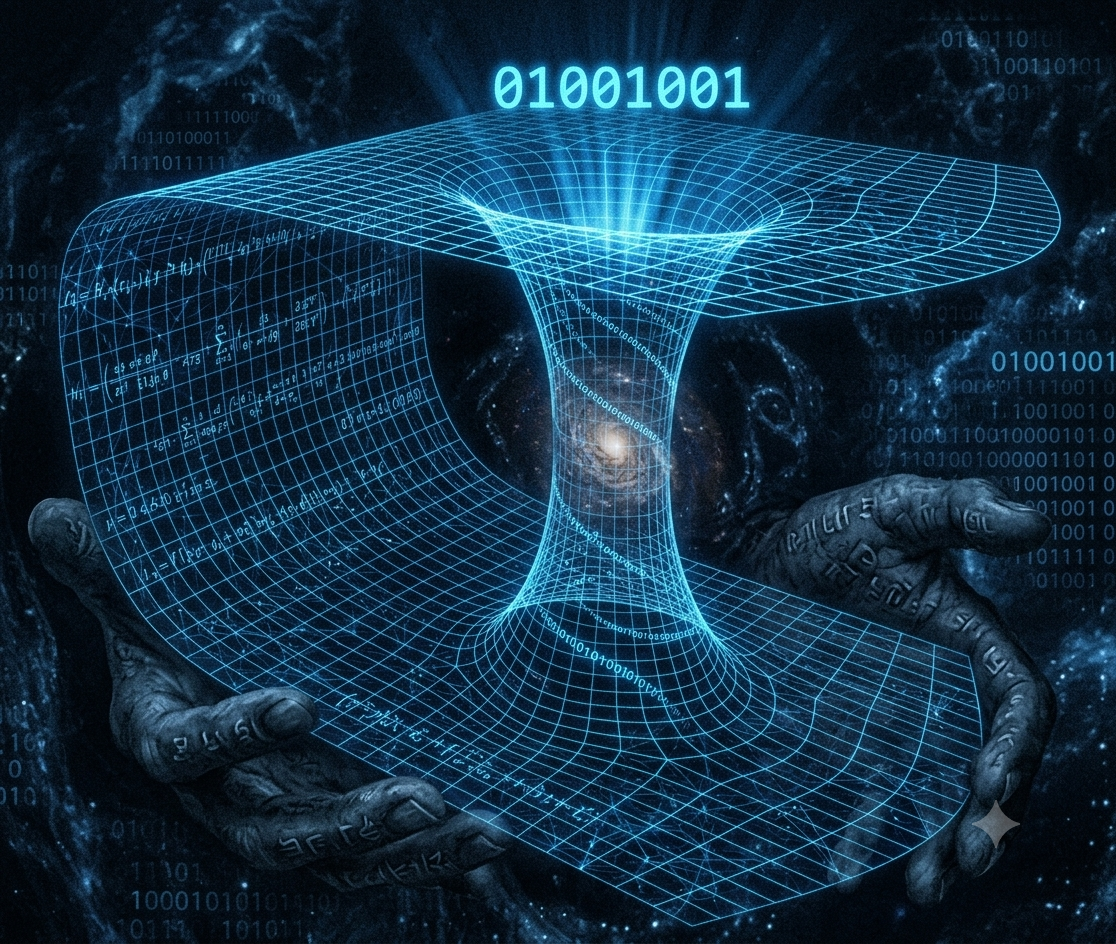
When we hear the word "wormhole", our brains instantly boot up pop-culture archives. We think of sci-fi epics where starships warp through massive, stable cosmic gates to cross the galaxy in seconds. In Star Trek: Deep Space Nine, the space station DS9 was located at one end of a magnificent wormhole inhabited by non-corporeal entities known as the Prophets. These beings existed entirely outside of linear time, rendering the past, present, and future as one single, accessible framework. To the nearby Bajoran people, they were gods; to the starships of the Federation, their highway through space was a mathematical miracle.
But mainstream physics quickly cuts the power to that fantasy. In general relativity, macroscopic wormholes are fiercely unstable. They are mathematically calculated to pinch shut and collapse into black holes faster than even a beam of light can pass through them. To keep one open wide enough for a Defiant-class starship, you would need to prop it open with "exotic matter"—hypothetical material possessing negative mass and energy density. Something that, as far as our current data shows, doesn't exist in nature.
But physics didn't stop there. It also left us a second, subatomic protocol operating in the quantum backend: quantum entanglement.
To understand what this means without the textbook jargon, imagine you have a single coin, but it’s actually composed of two separate, perfectly identical metallic discs stacked together. You separate the discs, put one in a box on your desk in Finland, and you send the other in a box to a friend in New York.
In the macroscopic world, that's just basic logic. If your friend opens the box in New York and finds the "tails" disc, they instantly know your disc is "heads." The state was determined the moment you split them. But the quantum backend doesn't play by macro rules. In the quantum realm, those two discs aren't locked as "heads" or "tails" during the journey. Until someone looks inside a box, both discs exist in a spinning, fluid state of superposition—they are simultaneously heads and tails. They are like an unrendered asset in a video game.
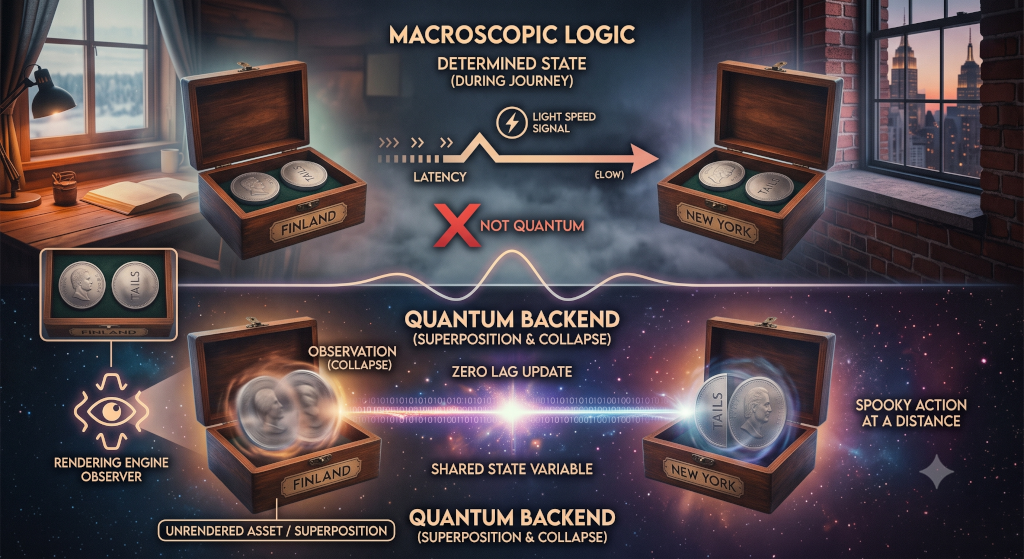
But the moment you open your box in Finland and the rendering engine forces that local disc to pick a state—say it lands on "heads"—its twin in New York instantly, mathematically, collapses into "tails" at the exact same microsecond. No signals were sent across the empty void; the two nodes updated with zero lag, completely bypassing the physical distance between them. This is what Albert Einstein, alongside Boris Podolsky and Rosen, famously and uncomfortably dubbed "spooky action at a distance"—the EPR paradox.
The deepest, almost comical irony here is that the blueprints for both of these distance-defying protocols were drawn by the exact same hand, in the exact same year. In 1935, Albert Einstein published those two separate papers (ER and EPR). Yet, for nearly eighty years, science treated these two concepts as completely separate, unrelated branches of the cosmic code. One was a massive gravitational tunnel ruling the cosmic scale of space-time; the other was a ghostly, subatomic data link operating between quantum particles.
This is exactly where my persistent gut feeling started to itch. Looking at these two phenomena side-by-side, it felt like a massive case of redundant engineering. Why would the universe build two completely separate ways to bypass distance? It felt like looking at the exact same system architecture, just viewed from two different development environments. Of course, science doesn't much care about a coder's gut feeling.
But as it turns out, the universe’s top architects eventually came to the exact same conclusion. In 2013, physicists Leonard Susskind and Juan Maldacena proposed a conjecture that sent shockwaves through mainstream cosmology, beautifully summarized as a deceptively simple equation: ER = EPR. They suggested that a wormhole and an entangled state aren't separate features—they are the exact same cosmic infrastructure looked at from different macro and micro viewpoints.
ER = EPR shifts the entire paradigm. We don't need exotic matter to stabilize a highway for spaceships, because these micro-wormholes aren't meant for physical transit. They are the background routing protocols of the cosmos. They don't carry matter; they anchor information.
To be completely honest with the data: despite our best efforts, we have never actually observed any wormhole of any kind on a macroscopic scale. Not a single microscopic quantum bridge has ever been detected in our most advanced laboratories, nor have our deep-space telescopes ever mapped a macroscopic gateway out among the stars. The cosmos, so far, remains stubbornly silent to our instruments—leaving traditional wormholes to exist purely as a fascinating premise within the realms of science fiction.
Yet, while the macro-wormhole end of the equation remains hidden, the quantum end is an indisputable, laboratory-proven reality. This isn’t just chalkboard theory anymore. Through rigorous testing, physicists have pulled entanglement out of the realm of abstract math and deployed it into the real world. We have successfully entangled particles across vast distances—not just across a lab bench, but through fiber-optic cables spanning entire cities and via satellite links whispering through the vacuum of space over distances exceeding 1,200 kilometers. In 2022, the pioneers of these very experiments were awarded the Nobel Prize in Physics, cementing the fact that this "spooky action" is a foundational law of our environment.
And it gets even wilder when you clock the network speed. In these real-world quantum optics experiments, scientists managed to measure the lower limit of how fast this state change occurs. They discovered that when one entangled particle is altered, its twin responds at a speed that is, at a bare minimum, 10,000 times faster than the speed of light—effectively instantaneous. We have literally logged the cosmic data transfer rate and proven that the latency between these nodes is zero.
But here lies the ultimate system restriction: due to the laws of quantum mechanics, we cannot use this instantaneous connection to send actual, usable, FTL messages. The data remains locked in a state of pure correlation until verified by traditional, light-speed methods. We have clocked the fastest network in existence, but we are barred from using it as a chat client—at least for now.
Instead, the universe has granted us a different administrative privilege: absolute, unbreakable security. While we can't warp data through this network to speed up our email or chats, we can use it for Quantum Key Distribution (QKD). Because a quantum state cannot be measured without collapsing it, any attempt by a Man-in-the-Middle to eavesdrop or tamper with the entangled key instantly destroys the fragile correlation. The hack leaves a glaring, mathematical footprint, alerting both nodes before a single byte of actual data is ever sent. The system is unurkiton; if you touch the packet in transit, you break the packet entirely.
There is a profound, almost comical irony in how we interact with the universe. We can observe the effects of gravity with staggering precision; we have built observatories like LIGO that can literally measure gravitational waves—the subtle ripples and warping of space-time caused by colliding black holes millions of light-years away. We can map the bending of light around massive galaxies, proving that the fabric of space curves exactly as Einstein predicted.
Yet, we still don't know what gravity actually is at a fundamental level, nor have we found a single wormhole, despite our equations promising they are perfectly valid code lines in the cosmic architecture. We are master mechanics staring at the engine's exhaust fumes, analyzing the heat output and the vibration, while the internal blueprints of the engine block remain entirely hidden from our sight. We treat gravity as a fundamental force that rules the 3D frontend of our world, completely blind to the fact that gravity might just be an emergent property—a macro-level consequence of quantum entanglement happening at the system’s deepest holographic boundary.
It’s as if the universe is sitting somewhere up in the tenth dimension, watching us celebrate our subatomic discoveries, quietly whispering to itself with an evil laugh: "FOOLED YOU!". We think we’ve cracked the source code just because we mapped the desktop icons, while the core operating system remains completely out of reach.
This brings us back to the architecture of our own existence. If space-time is not a solid, pre-existing highway, but a dynamic mesh generated by quantum connection, then the boundaries of our private bubbles are far more fluid than we think.
Think of it as a massive, decentralized data network. When we look at the universe through our biological senses, we see a vast 3D landscape with massive distances. But that 3D world is just the frontend. In the backend, everything is running on a low-latency quantum database. Two particles on opposite sides of the galaxy that are entangled aren't sending signals across the empty void; they are connected directly via a micro-wormhole. They are two local folders synced to the exact same cloud server. Distance is just an illusion generated by the rendering engine to keep our local user interface from crashing.
We spent Chapter 4 establishing that each conscious mind renders its own isolated universe, running on its own local refresh rate—a sovereign server with no windows. But ER = EPR provides the hidden network cables. It implies that at the deepest, subatomic backend, your server and my server are not drifting in a silent vacuum. Our worlds are continuously cross-routed through this low-latency quantum mesh.
The conclusion is as beautiful as it is haunting: We don't need to break out of our bubbles to connect with the universe, because our bubbles are already wired into its core.
When you experience those rare, inexplicable moments where reality seems to align perfectly—when two minds click in absolute synchronization across a crowded room, or when an idea flashes into existence simultaneously on opposite sides of the globe—you aren't witnessing a statistical miracle. You are catching a glitch in the interface. For a split second, the rendering engine lag spikes, and you see through the desktop icons straight into the low-latency network code. You realize that "distance" was just a parameter meant to keep your localized brain from crashing under the weight of infinite data.
We are not lonely observers looking at a cold, distant cosmos from behind a window. We are local nodes of a single, deeply entangled system, looking back at ourselves. The universe isn't just out there among the stars; it’s right here, routing its data through the micro-wormholes that hold our very bodies together. And no matter how loud that tenth-dimensional evil laugh echoes through the physics labs, the code remains clear: everything is connected, and the latency is zero.
About the author
- I am a seasoned software engineer with experience in most of the common programming languages but C++, C#, Java are my favorites. I am also a die hard gamer and a independent music composer and producer.
Comments
Join the discussionNo comments yet. Be the first to comment.
A Small Wave in a Big Ocean
My ongoing series of posts relating to my manuscript called "A Small Wave in a Big Ocean". For the longest time, these fragments stayed hidden in my drafts. I was afraid they were too abstract, too unpolished, or perhaps just too personal. But as I’ve started this Signal Sanctum blog, I realized that this is exactly the place for them. Think of these posts as the foundations, or the philosophy, behind the Signal Sanctum.