
Chapter 20: The Lazy Evaluation of Reality
Positioning the Superposition

We spent the previous chapter tracking the absolute deepest backbone network of our cosmos. We discovered that the universe looks like it is running a low-latency routing protocol summarized by the deceptively simple equation ER = EPR—proving that space-time distances are just a frontend illusion, and that underneath the laggy macro-world, particles are directly cross-routed via microscopic wormholes.
But as any backend architect knows, you don’t normally build a global, zero-latency shared state database just for fun. You build it because the data it handles is so fragile, and so critical to the system’s structural integrity, that any synchronization lag would cause a fatal crash.
To understand what that data actually is, we need to look at how the cosmos manages its system resources. We need to talk about superposition.
Before we pull up the terminal and look at the logs, let’s drop an important system anchor: I'm not here to sell you the Simulation Theory. Also I'm not claiming that the cosmos is a literal, silicon-based video game running on a giant server in some alien teenager's basement. Rather, I'll be using these technological metaphors as an architectural bridge. By mapping quantum anomalies onto data structures and game engine-like logic, we can entangle ourselves with concepts that otherwise remain locked behind walls of abstract academic math. I'm using the language of the coder simply because it is the cleanest interface we have to translate how reality actually operates.
Upgrading to Macro Hardware
Entangling the Frontend
When we talk about subatomic particles drifting in a vacuum, superposition and entanglement feel safe. They feel like isolated backend code running in a sandbox environment where it can't do any harm to our everyday user interface. But physics didn’t stop at the micro-level.
To understand how deep this rabbit hole goes, we first need to look at what superposition actually means under the hood. Mainstream education loves to present it as a mystical, impossible paradox where things can be "two things at once". But to a programmer, it is the universe’s native implementation of Lazy Evaluation—not calculating the state of an asset until the exact microsecond another process demands it.
To prove that this isn't just a convenient developer metaphor, we can look at the foundational code-leak of quantum mechanics: the Double-Slit Experiment.
Imagine a laboratory setup where a physical "particle gun" fires individual electrons at a barrier with two thin parallel slits cut into it, with a detection screen waiting behind them.
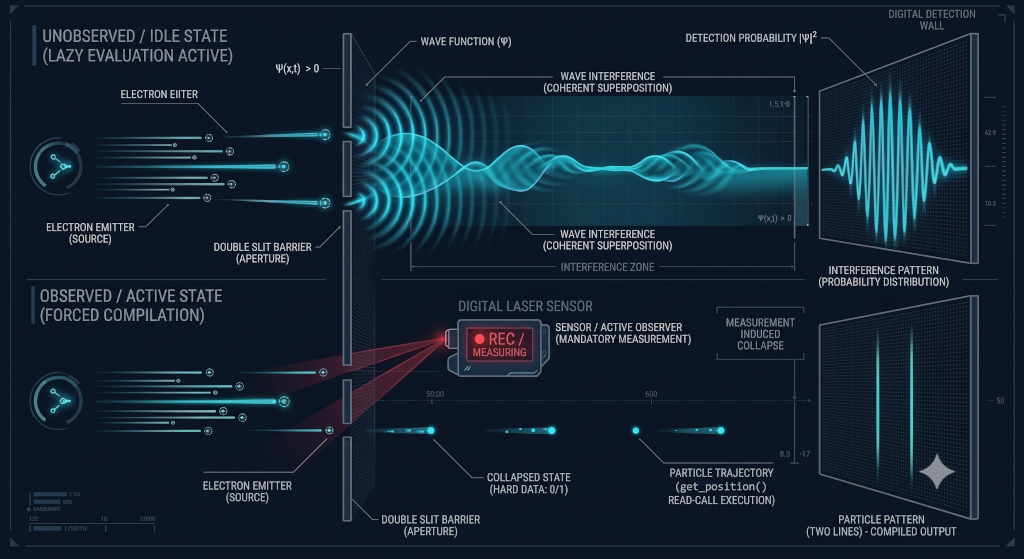
The Idle State (No Observer): When scientists run the experiment without any monitoring devices at the slits, the electrons behave like waves. Each individual particle passes through both slits simultaneously, interfering with itself like ripples in water, and creates a complex interference pattern of multiple stripes on the back wall. The universe’s rendering engine is running in an unrendered, fluid state of probability. It doesn’t lock down a definitive position because no process is asking for it.
The Active Read-Call (The Observer): The moment scientists place a measuring sensor next to the slits to log exactly which hole the electron actually passes through, the system behavior changes instantly. The wave function collapses. The electrons stop acting like fluid waves and begin acting like hard, classical marbles—passing (particles) through one slit or the other, leaving a blunt pattern of just two straight lines on the wall.
The systemic takeaway is mind-bending: The act of measurement forces the system to compile. By placing a sensor there, you are like executing a mandatory get_coordinates() like read-call on the backend. The universe's engine can no longer lazy-evaluate the asset; it is forced to drop the probability cloud, collapse the superposition, and commit a hard 0 or 1 to the local environment.
And the rendering engine's interface has an even stricter data-masking security protocol built into it: Heisenberg’s Uncertainty Principle.
In the macro-world's user interface, we assume that every object has a definitive position and a definitive speed at all times. But in the quantum backend, the universe runs a strict rate-limiting policy on its data variables. You are mathematically barred from reading both the exact position (x) and the exact velocity (p) of a particle at the same microsecond.
Think about how this logic operates even in our everyday macro-world. If you want to log a moving car's exact position, you only need a single, instantaneous snapshot. You freeze the frame, and you have the exact coordinates. But to measure its speed, a single snapshot is completely useless. You mathematically need a delta—you need two separate position logs and the exact amount of time that ticked between them (v = dx/dt). Speed requires history; it requires multiple frames of data.
It’s a foundational problem that practically 100% of game developers and network engineers have wrestled with: interpolation and extrapolation. If you have a lagging object moving across a screen, you cannot calculate its path between two updates (interpolation), nor can you predict where it will head in the next frame (extrapolation) using just a single event's spatial data. You need a minimum of two points just to calculate a basic linear vector, and significantly more historical data if you want to map acceleration or curves.
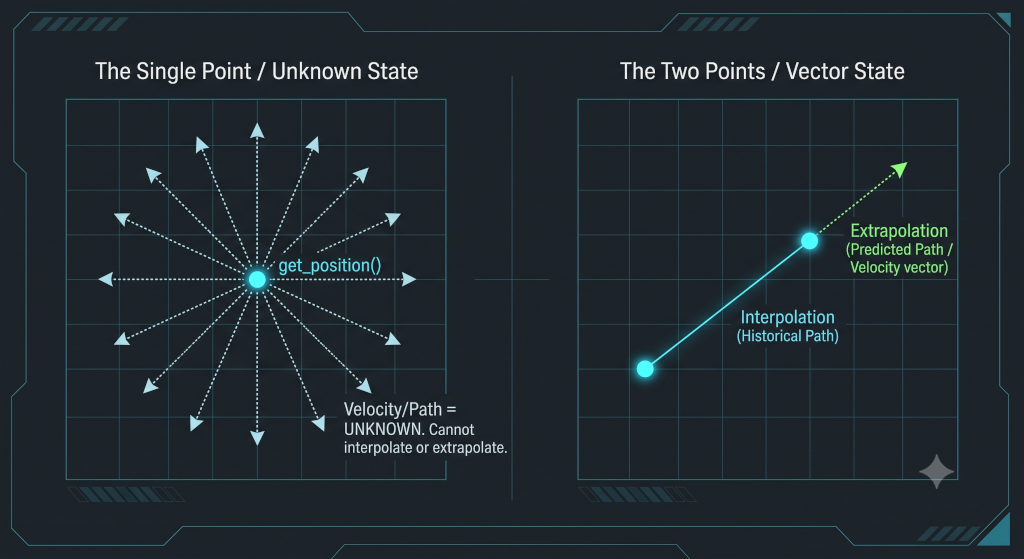
In the quantum backend, the same hardware rule applies, but with brutal architectural consequences. If you execute a high-resolution query to freeze a particle to fetch its exact coordinates (like get_position() call), you are effectively pausing the video on a single, ultra-precise frame. By destroying the wave's historical timeline and delta data to map its exact location, you completely break the system's ability to interpolate or extrapolate its motion. The system architecture automatically wipes out the velocity data. If you pivot and try to measure its momentum over time, you lose the pointer to its exact location.
It is not a limitation of our laboratory instruments; it is a hardcoded system restriction. The universe refuses to let you map both parameters to a single local state, proving that reality at its core is a fluid, probability-driven database that actively resists being fully cached by the observer.
And this is where the modern hardware race gets wild. For nearly a century, we thought this rendering trick only applied to single, invisible particles running in that subatomic sandbox. But over the last few years, scientists have begun pushing these uncompiled, fluid quantum states directly into macro-level hardware.
This isn't just clickbait; it is recorded laboratory data. Here is what we have actually managed to push to production in the macroscopic world:
Clouds of Millions of Atoms: Researchers have successfully created and observed long-lived quantum states between gas samples and clouds containing up to roughly 16 million atoms simultaneously. The universe isn't just managing single bits; it’s batch-processing massive clusters of data.
Microscopic Drums (The Aalto & NIST Experiments): Scientists at the National Institute of Standards and Technology (NIST) and Aalto University in Finland successfully entangled the collective motion of two vibrating microscopic drumheads. These drums, roughly one-fifth the width of a human hair, were made of billions of atoms. Yet, they vibrated in perfect, synchronized quantum correlation. It’s like having two physical hard drives sharing the exact same mechanical state across a network link.
Millimeter-Sized Diamonds: Physicists at Oxford University took macroscopic, millimeter-sized diamonds and successfully entangled their internal vibrational states (phonons) at room temperature.
The Cryptobiosis Incident (The Tardigrade Experiment): In late 2021, an eye-catching experiment claimed to have entangled a microscopic, multicellular animal—a tardigrade in a state of cryptobiosis—with two superconducting qubits. While it grabbed headlines, the system logs sparked a heavy debate in the physics community. Many architects argue the tardigrade merely acted as a classical piece of insulation (a dielectric material) that shifted the circuit's clock rate, rather than entering a true, shared quantum state itself. The code on this one is still under review.
The Catch: Environmental Noise
While macro-level quantum states are a reality, they face a brutal system restriction: Quantum Decoherence.
The bigger an object is, the more it interacts with the environment. Every stray photon, every microscopic temperature fluctuation, and every kinetic vibration acts like an unhandled exception or external noise flooding the server. It triggers an accidental read-call, forcing the fluid wave-function to collapse prematurely.
To keep these macro-objects in a state of superposition or entanglement, scientists have to run the hardware in extreme, isolated development environments—near absolute zero temperatures (-273.15°C)—where the kinetic "noise" of heat is completely frozen out. If you want to keep the data unrendered, you have to keep the server completely quiet.
Weaponizing the Operating System
Quantum Computing and the Qubit
We aren't just flashing lasers at microscopic drums for academic street cred. Theoretical physicists and computer engineers are actively using these macro-level quantum states to bypass the physical limits of Silicon Valley hardware. We are building quantum computers.
In a traditional, classical computer, the absolute lowest level of architecture is the binary bit. A bit is a physical transistor that acts like a strict light switch: it can either be off (0) or on (1). Every application you’ve ever written, every database you’ve optimized, and every desktop icon you've rendered is just a massive, complex skyscraper built out of these microscopic 0s and 1s.
A quantum computer, however, throws out the traditional switchboard and replaces it with the Qubit (quantum bit). Thanks to superposition, a qubit doesn’t have to choose between being a 0 or a 1. Until the computation is complete and the final state is read, the qubit exists as a fluid, spinning combination of both states simultaneously.
To see what this administrative privilege actually enables, think about a classic coding problem that practically every software engineer has faced: finding the shortest route through a massive graph or network.
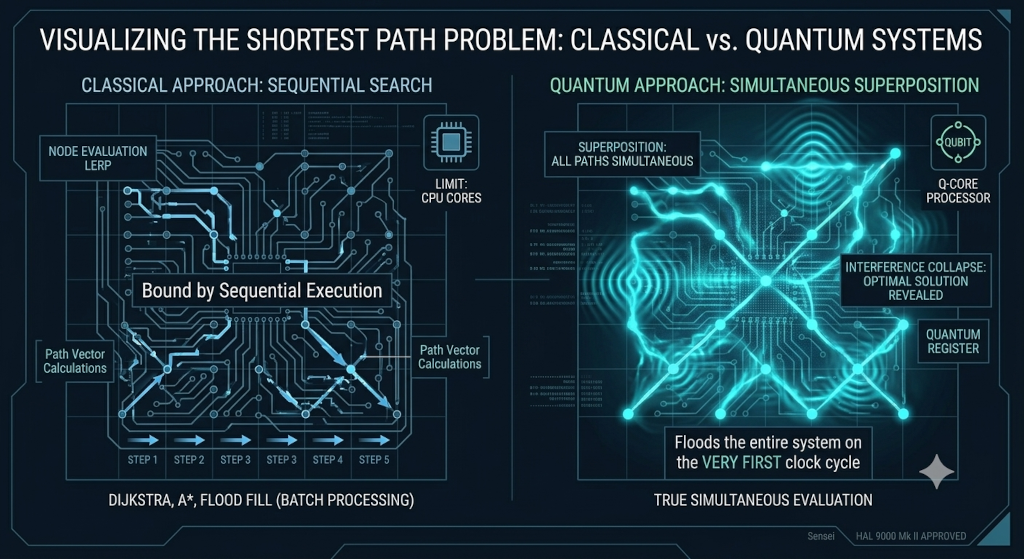
The Classical Approach (Dijkstra, A*, and Multi-Threading): When a traditional CPU calculates the optimal path, it is bound by sequential execution. Even our most brilliant graph algorithms—like Dijkstra’s algorithm or an optimized A* search—have to evaluate the nodes step-by-step. Sure, you can introduce modern multi-threading and split the workload across multiple CPU cores to test different paths simultaneously. But even then, your hardware hits a brutal physical ceiling. You are hard-limited by the number of physical cores (be it 8, 16, or 64). If the maze has billions of permutations, those threads still have to batch-process the loops sequentially. The architecture is still just brute-forcing the queue.
The Quantum Approach (True Superposition): A quantum computer doesn't just split the queue among a few threads; it eliminates the queue entirely. Because its qubits exist in a state of superposition, the single quantum register holds all potential paths simultaneously. It doesn't crawl through the network node-by-node or core-by-core; it floods the entire system at once, allowing the correct, optimal solution to interfere constructively and reveal itself on the very first clock cycle.
But superposition alone isn't enough to build a functioning system; you also need a way to link these bits together to form registers. This is where quantum entanglement steps in as the ultimate hardware bus.
By entangling multiple qubits together, their states become interconnected via that low-latency ER = EPR mesh we talked about. If you have a 300-qubit processor and all those qubits are perfectly entangled in a shared superposition, the computer isn't just processing 300 states. It is processing 2^300 states simultaneously—a number that is mathematically larger than the total number of atoms in the entire observable universe.
We are literally hijacking the universe's backend rendering engine to run computations that would take a traditional supercomputer billions of years to execute. We are using the cosmos’s own lazy evaluation algorithms to crack cryptography, optimize complex logistics, and model quantum chemistry in seconds.
The Grand Architecture: Why the Cosmos Cheats
When you step back and look at the massive architectural web we’ve spent 20 chapters weaving together—from the pixelated limits of the Planck length to black hole storage drives, holographic screens, and low-latency wormhole networks—this mind-bending metadata architecture finally snaps into place.
Why does the universe fight so hard to maintain these fragile quantum states? What does the cosmic operating system actually gain from keeping its backend in a constant dance of superposition and entanglement?
The answer is absolute resource optimization. The universe, at its core, is the most efficient software architect ever written. It runs on three fundamental engineering principles:
Memory Conservation via Lazy Evaluation: By refusing to compile or render the definitive state of a particle until an active
read()call (observation) is made, the universe saves an unfathomable amount of raw processing power. It doesn’t waste system resources rendering detailed textures, positions, or velocities for entities drifting in the dark, unobserved background of the void. It keeps them as lightweight, fluid probability functions until the very last microsecond.Data Compression via Entanglement: Instead of storing independent, isolated memory registers for every single asset in existence, the universe uses entanglement to batch-process its state clusters. Two entangled particles don’t require two separate, heavy synchronization loops; they share a single, interconnected state.
Synchronization Insurance via \(ER = EPR\): This is where Chapter 19 and Chapter 20 perfectly merge. When an observation finally occurs, and a fluid superposition is forced to collapse into a hard reality, the universe cannot afford system desynchronization. If Particle A collapses here, its entangled counterpart across the galaxy must instantly match that state to prevent a logic bug in the universal database. The zero-latency wormhole mesh of ER = EPR is the physical hardware bus that ensures this synchronization happens at absolute zero lag.
We have spent twenty chapters pulling back the curtain on modern physics, only to realize that the universe isn't a chaotic, mystical soup of paradoxes. It is a beautifully optimized, self-correcting, low-latency system. It is an intricate architectural web where space and time are just a clever user interface designed to stream a massive, fluid, probability-driven backend database directly to our senses.
We’ve finally mapped out the hardware, verified the network speeds, and decoded the memory management algorithms. We could say the system is stable, deployed, and running live in production.
But when you strip away the tech talk and the physics jargon, what we are left with is a completely new way to look at our own existence. We’ve spun a massive web over these past twenty chapters, trying to find a language that makes sense of the impossible. And as it turns out, the language of the coder—of rendering engines, networks, and lazy evaluation—brings the vast, cold cosmos just a little bit closer to home.
There is only one thing left to do before we close this chapter, gather our thoughts, and begin shaping this entire journey into a final book. We need to take one last step back and look at the truly big picture.
See you in Chapter 21 for the final review and conclusion.
About the author
- I am a seasoned software engineer with experience in most of the common programming languages but C++, C#, Java are my favorites. I am also a die hard gamer and a independent music composer and producer.
Comments
Join the discussionNo comments yet. Be the first to comment.
A Small Wave in a Big Ocean
My ongoing series of posts relating to my manuscript called "A Small Wave in a Big Ocean". For the longest time, these fragments stayed hidden in my drafts. I was afraid they were too abstract, too unpolished, or perhaps just too personal. But as I’ve started this Signal Sanctum blog, I realized that this is exactly the place for them. Think of these posts as the foundations, or the philosophy, behind the Signal Sanctum.