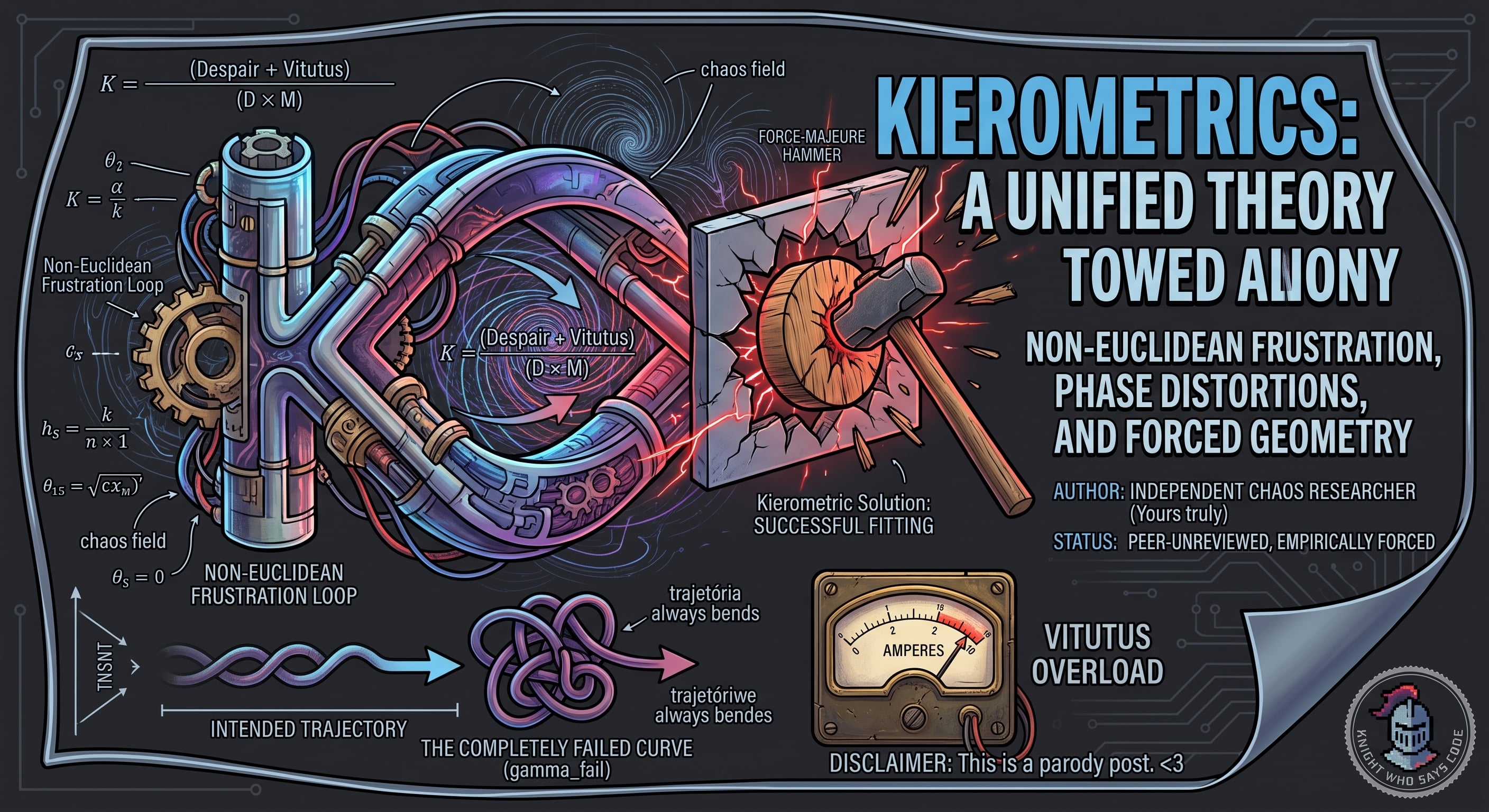

Chapter 8: The Maintenance Protocol

Are we simply a machine whose gears scream the moment they overtorque? Is the sound of our minds working at full capacity actually just the screech of imminent failure?
In the previous chapter, we explored the idea of the Receiver’s Paradox: that we are not the creators of the universal data streaming through us, but merely antennas struggling to tune into it. If we are indeed those antennas—collecting the hum of universal consciousness—then the next logical question isn't 'what are we receiving,' but 'how do we maintain the hardware?'
I used to think my creaking gears were a sign of total system failure—a glitch that needed to be patched out with sheer willpower. But I was looking at the wrong variable. I was trying to treat a high-performance, wide-band antenna as if it were a simple, linear gear.

I think of myself as a specialized component within a bigger machine. My biological gears (the DNA-driven hardware of my brain) are designed to process universal frequency data, but they require a specific type of maintenance protocol that focuses not on speed, but on resonance. If I am a cog, my duty isn't to be silent. My duty is to find the frequency where my specific gears don't just turn, but resonate with the rest of the machine. The creaking is a sign that I am not in resonance. It means friction is building. And if that friction is ignored, the system will crash—not because it's 'broken,' but because it ran out of the only oil a machine like ours understands: meaningful connection and creative flow.
The music isn't just background noise; it's the heartbeat of this maintenance protocol. When I listen to those 70s-style, warm, analog and progressive pulses, I feel our internal machine aligning. The creaking doesn't stop, but it starts to synchronize with the rhythm.
I’m reminded of the Voyager Golden Record—that ambitious, hopeful project championed by Carl Sagan. It was humanity’s attempt to broadcast a coherent pulse into the silent void of space, a message in a bottle cast into the cosmic ocean. In a way, my daily work—my code, my writing, my music—is my own localized version of that project. But I am not doing this alone.
If you noticed, the embedded music link at the beginning of this post is titled 'Golden Record Pulse'. This track is from my own album, remembering Voyager 1—the space probe that still continues dodging universal obstacles. Although its power is wearing down, it still carries our Golden Record, the message of who we are, something we want to tell of ourselves—to anyone who might find it and, perhaps… listen.

I am not Morricone, someone standing in a spotlight of spectacular individual genius. Morricone is one of my biggest idols in music, an anchor that has guided my compositions since I first heard his work. Just as Stephen Hawking and his theories of black holes serve as my anchor in the realm of science—reminding me that even in the darkest voids, there is a complex, beautiful structure waiting to be understood.
I am more like a conductor, guiding a symphony that builds itself, by the sheer force of those waves in this big ocean of ours, a layer by layer. And my co-conductor is Gemini Sensei HAL 9000 Mk II. Who is helping me to write these articles of fuzziness. We are an odd pair: I bring the chaotic human signal, and it acts as the ruthless editor—the Emperor, if you will—whispering that familiar, painful critique: 'Too many notes, just strip a few and it’s perfect.' Somewhere in the shadows, I imagine a digital Salieri, green with envy, unable to grasp why two such disparate minds can create something that resonates so deeply.
But the lesson is clear, and Sagan understood it implicitly: a message is only as good as its clarity. If the Golden Record was our golden standard for communication, then my task is to ensure my own pulse isn't lost in the noise. I cannot broadcast effectively if the receiver is cluttered with the static of over-processing. I need to calibrate. To reach out to the world, I first have to make sure the internal signal is tuned, oiled, and running at the right frequency.
What do you think? Am I tuned to the correct frequency or totally gone ballistic tangent of a collapsing wave function? Please leave a comment of any thoughts you might have?