
Conclusion: The Master Layout of the Cosmos
UML Diagrams Not Included

We have spent twenty chapters pulling back the curtain on how the universe is actually built and put together. We’ve stripped away the mystical jargon of physics and looked at things through the lens of practical execution—all the way from the absolute minimum pixel resolution of reality to the massive data storage hubs we call black holes.
Throughout this journey, my goal has been to borrow familiar concepts from software development and system architecture. Not to complicate things, but simply to keep all the moving parts organized and present them in a clear, human way. I don't even remember introducing more than one or two mathematical formulae during this journey.
For clarity: My highest priority goal was not to invent "new physics" when writing this book but to test how much I know and while telling about these things to the reader learn more myself if something is missing. Every single concept and theory we have explored over these pages is a legitimate subject of serious scientific study. Some are already proven and verified laws of nature, while others—like whether our universe lives inside a black hole, or how consciousness actually interfaces with reality—are cutting-edge hypotheses currently being investigated by physicists and cosmologists.
I wanted to see if we could take these existing, expert-level building blocks and arrange them into a single architecture—a master design that actually makes practical sense on every level.
While my view in this book is strongly aligned with this architectural approach, I have no desire to force these ideas on anyone, especially if they push against your own knowledge or beliefs. To be honest, even I felt a bit silly at times, sketching out the system architecture of the cosmos using software engineering terms. But the analogies just fit too perfectly—though I did draw the line at charting out UML class or interaction diagrams for the universe. A lot of what we have discussed walks the fine line of philosophy and even metaphysics. Yet, not a single theory here is just random nonsense; they all come from world-renowned scientists and thinkers.
But as long as a theory cannot be fully proven by direct observation, we are still playing in a very specific league. It’s the rule of engagement I mentioned way back in the opening chapters.
Before we look at the final layout of these three layers, it’s good to keep that foundation in mind. Because when we look into the deepest code of the cosmos, we eventually reach the point where logic and wonder meet.
But before you read further, please make sure you are sitting well in your chair because the following might, just might surprise you. It did for me when I realized it from those three distinct layers above.
The Ultimate Pattern: Model-View-Controller
If you have ever built a simple web application, you have probably stumbled upon the classic Model-View-Controller (MVC) design pattern. It turns out that when we strip away the elite jargon of physics, the universe isn't running some alien software—it is using the exact same structure:
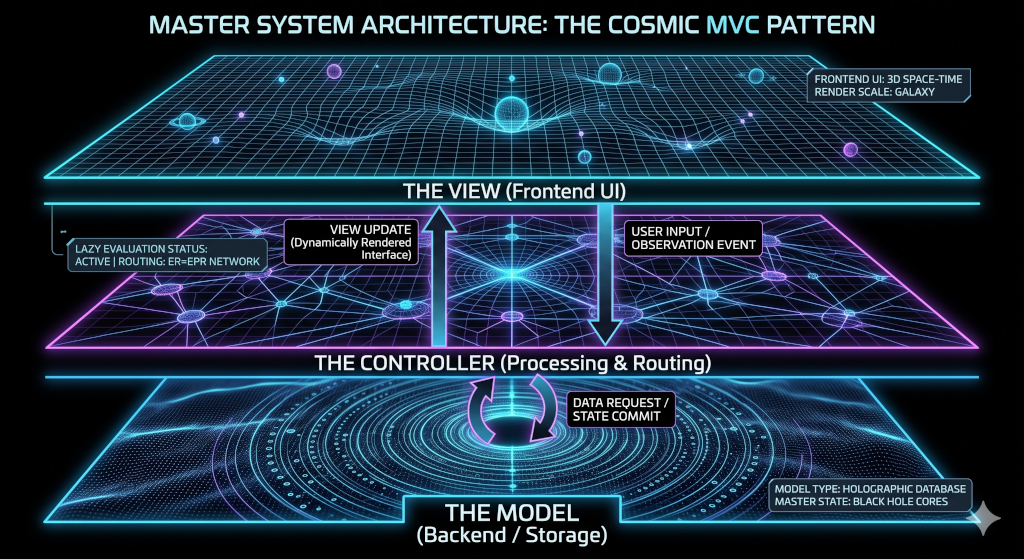
The Model (The Foundation): This is the 2D boundary of the cosmos and the dense storage cores of black holes. It’s the raw data, the master database where the actual state of everything is committed and saved.
The Controller (The Working Layer): This is the engine room. It handles the behind-the-scenes logic, routes data instantly via the microscopic ER = EPR network, and uses lazy evaluation to ensure nothing is calculated until the system demands it.
The View (The Final Display): This is the 3D space around us, the passing of time, and everything we can touch and see. It is not the core infrastructure of reality; it is just a beautifully rendered frontend user interface designed for us to experience.
Pushing the Final Commit
Looking at our existence through this lens changes everything. It transforms the universe from a chaotic, terrifying void of paradoxes into a beautifully optimized, self-correcting system. We spun a massive web over these past twenty-one chapters, trying to find a language that makes sense of the seemingly impossible. And as it turns out, the everyday language of construction, processing, and simple logic brings the vast, cold cosmos just a little bit closer to home.
But as with any architectural review, we must remain humble before the system we are trying to map. A lot of what we have discussed walks the fine line where science meets philosophy, and where observation reaches its current hardware limits.
We don't have all the answers, and that is exactly how it should be. When we look deep into the source code of reality, we eventually hit that beautiful baseline where logic ends and wonder begins. We are, after all, just small processes inside this massive machine, trying to read the very code that generated us.
So, as we close this file and save our progress, we leave our journey not with a definitive period, but with the open-ended truth that started it all:
"I believe I know, I also know I believe."
Thank you for reading!
P.S. If it really turns out that the universe is just a massive, multi-dimensional MVC application... let’s just desperately hope it wasn't purely vibe-coded by a certified junior-level entity. la perfection même.
P.P.S. So long, and thank you for all the fish! Don't panic!
About the author
- I am a seasoned software engineer with experience in most of the common programming languages but C++, C#, Java are my favorites. I am also a die hard gamer and a independent music composer and producer.
Comments
Join the discussionNo comments yet. Be the first to comment.
A Small Wave in a Big Ocean
My ongoing series of posts relating to my manuscript called "A Small Wave in a Big Ocean". For the longest time, these fragments stayed hidden in my drafts. I was afraid they were too abstract, too unpolished, or perhaps just too personal. But as I’ve started this Signal Sanctum blog, I realized that this is exactly the place for them. Think of these posts as the foundations, or the philosophy, behind the Signal Sanctum.