

Kierometrics: Towards a Unified Theory
Non-Euclidean Frustration, Phase Distortions, and Forced Geometry
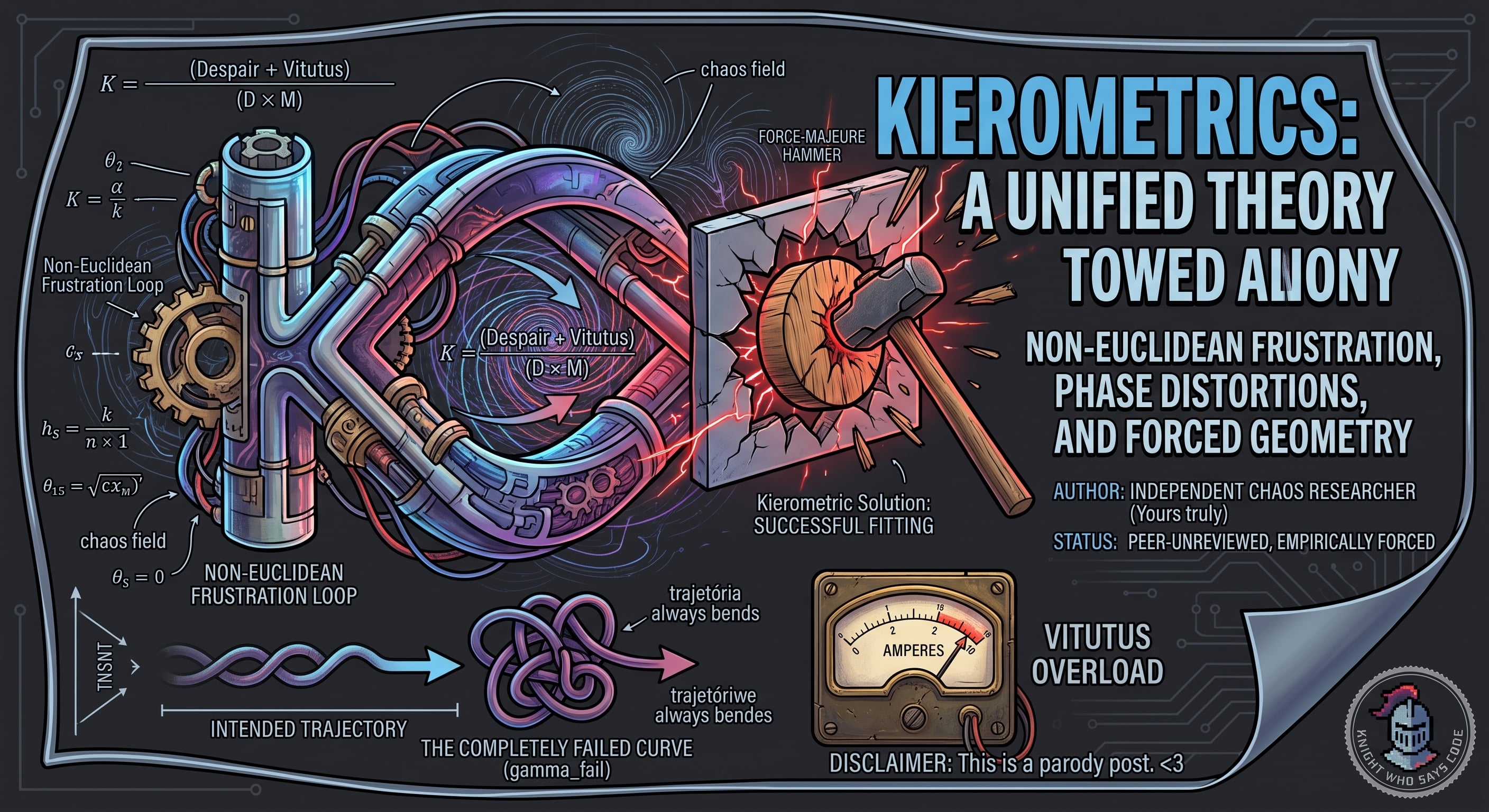
Author: Independent Chaos Researcher (Yours truly)
Status: Absolutely Peer-Unreviewed, Empirically Forced
Disclaimer: This is a parody post. We don't have to take everything too seriously <3
Abstract
Classical mechanics, quantum electrodynamics, and modern software engineering all share a single fatal flaw: they assume that with enough optimization, things will eventually fit. In this paper, we introduce Kierometrics (Finnish: Kierometria), a non-Euclidean framework explaining why systems inevitably distort, why components resist alignment, and how applying macroscopic kinetic energy (force-majeure hammer) remains the only deterministic solution to structural incompatibility.
1. Fundamental Postulates
Kierometrics departs from classical Euclidean assumptions and introduces three primary constants governing everyday reality:
The Failed Bend Theorem (κ_f): No trajectory in project planning or mechanical assembly is ever truly linear. Any attempt to draw a straight line between point A and point B introduces an unprompted, irreversible bend.
The Universal 15-Degree Phase Distortion (θ₁₅): Regardless of calibration, all physical and logical systems maintain an inherent 15-degree skew. This explains why cigarettes burn down one side unevenly and why production deployments fail exclusively at 16:00 on Fridays.
The Non-Kirchhoff Current Leakage: Current (and patience) does not sum to zero at a node. Instead, the surplus energy dissipates directly into the surrounding atmosphere as pure existential friction.
1.1 Special Case Study: The Completely Failed Curve (Täysin Epäonnistunut Mutka)
In advanced Kierometrics, the Completely Failed Curve (γ_fail) represents a catastrophic breakdown of geometric intent. Unlike standard topological curvature, which adheres to continuous differential geometry, a Completely Failed Curve occurs when a trajectory attempts to round a corner but instead:
Loses Structural Integrity: The arc terminates prematurely at a nonsensical angle (≈ 15° offset).
Generates Localized Friction: Induces immediate, unrecoverable existential irritation in the observer.
Refuses Euclidean Rectification: Cannot be corrected by standard smoothing algorithms, requiring the operator to simply abandon the coordinate space altogether.
Mathematically, the path integral of a Completely Failed Curve over time t yields no spatial displacement, only accumulated heat and sighing:
$$\oint_{\gamma_{\text{fail}}} \vec{F}_{\text{effort}} \cdot d\vec{r} = -\infty$$
2. The Mathematical Model: The Extended Frustration Index
To quantify structural and emotional viability across distributed systems, we propose the Kierometric Viability Equation:
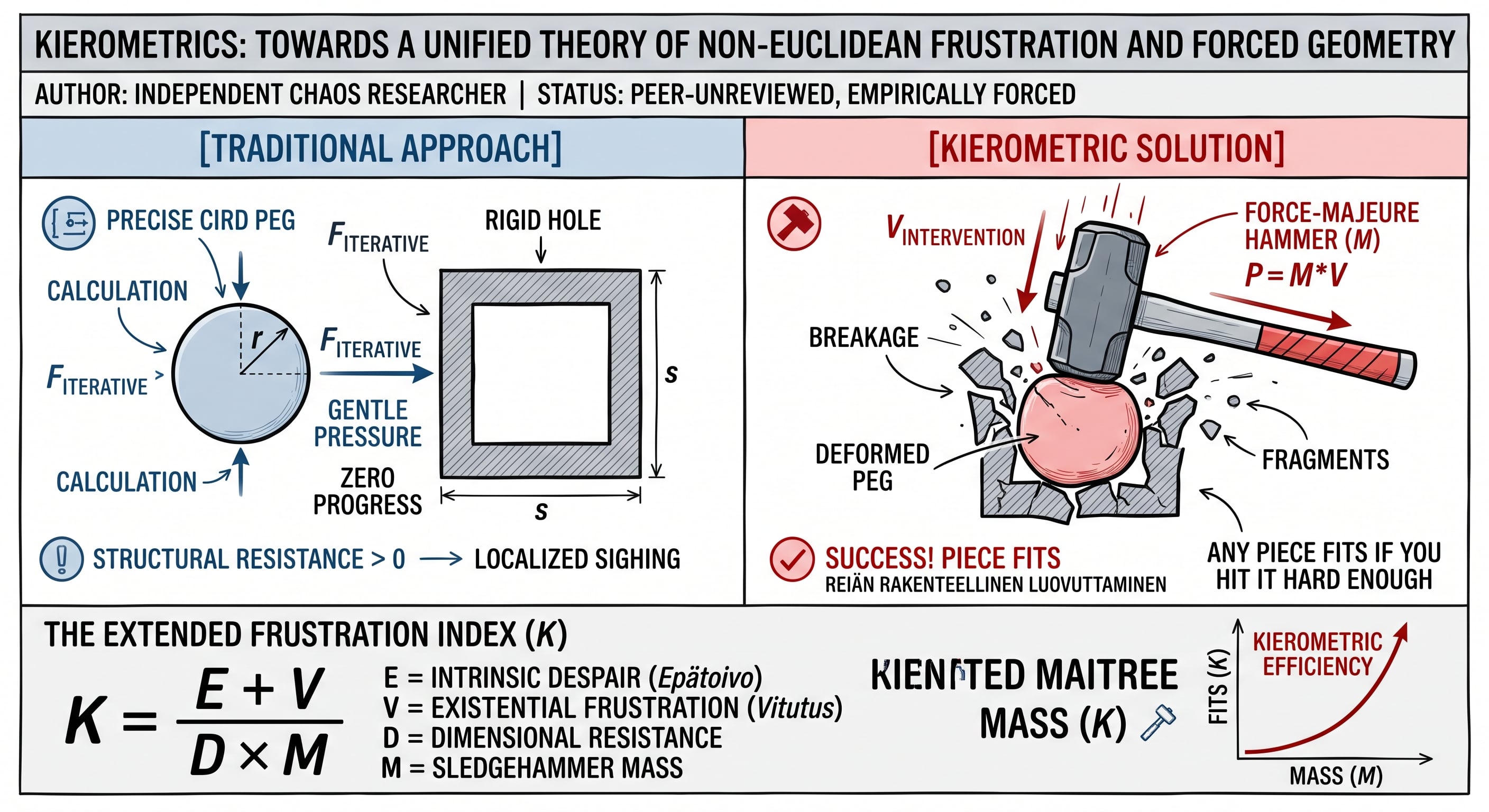
$$K = \frac{(E + V)}{D \times M}$$
Where:
K = Kierometric Viability Index (dimensionless)
E = Intrinsic Despair (Epätoivo)
V = Existential Frustration (Vitutus)
D = Dimensional Resistance / Spatial Obstinance
M = Sledgehammer Mass (kg)
Note: As M → ∞, structural resistance approaches zero regardless of boundary conditions.
3. Empirical Validation: The Sledgehammer-Assisted Fitting Test
To demonstrate the validity of Kierometrics over rigid Euclidean dogma, an empirical trial was conducted:
Setup: A circular wooden block was positioned above an equilateral square aperture of inadequate dimensions.
Standard Protocol: Applying gentle, iterative pressure resulted in zero forward progress and elevated localized sighing.
Kierometric Intervention: A 5 kg force-majeure hammer was introduced with high velocity.
Result: The circular block successfully occupied the square aperture. Structural integrity of the boundary was compromised, confirming that any piece fits if you hit it hard enough.
4. Conclusion & Future Work
Kierometrics demonstrates that reality is not broken—it is simply permanently skewed by 15 degrees. Rather than fighting entropy, researchers are encouraged to embrace the bend, minimize unneeded micro-optimizations, and keep a calibrated mallet nearby.
Future research will investigate:
Fluid dynamics of barley-based relaxation agents at local establishments.
The escape velocity required to exit narcissistic singularities in middle management.
Note on Empirical Data: High-precision laser interferometry was temporarily suspended due to non-removable Pigeonite deposits on primary optical sensors. Attempts at chemical rectification via domestic drain cleaner resulted only in localized existential vapor.
Disclaimer: No actual physics or Euclidean shapes were permanently respected during the production of this manuscript.


